

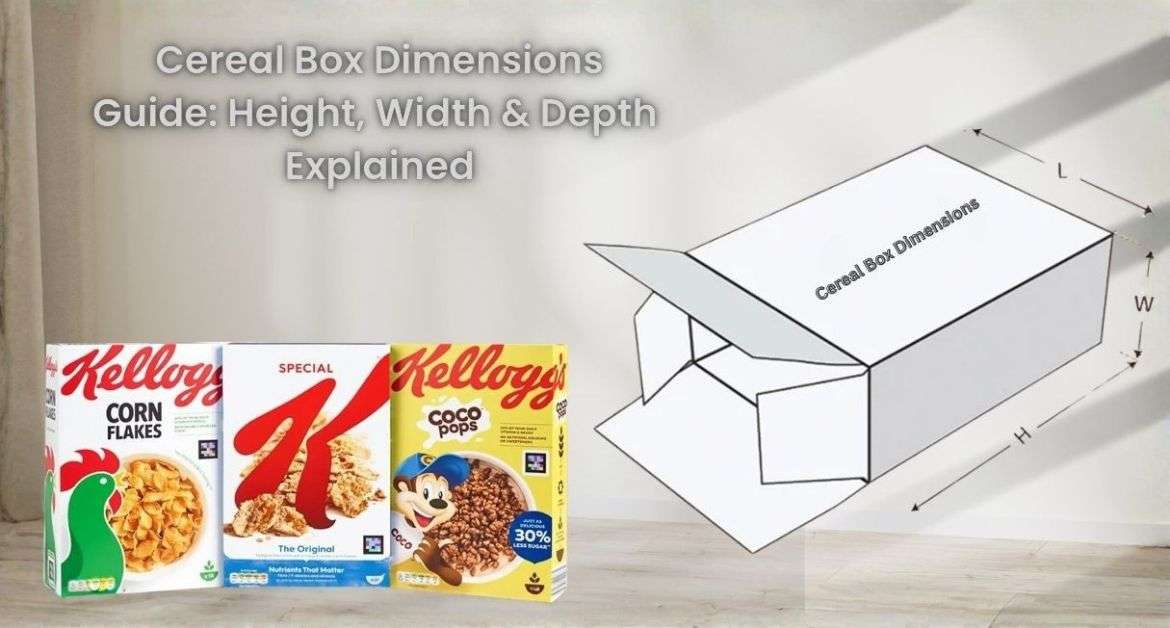
Have you ever noticed why some cereal boxes are neatly aligned on shelves while others look off? This is not an accident, but rather due to accurately measured cereal box dimensions and a carefully designed strategy. A right-sized box not only secures the cereals but also immaculately fits onto the shelves. It also attracts buyers and reduces the shipping costs.
In competitive markets, the master packaging businesses with accurate box dimensions have a strong edge over others. We have discussed the cereal box sizes, how tall they are, and every little detail to win the retail space as well as the customer’s attention.
How Dimensions Influence Cereal Packaging Design?
The right dimensions for cereal box packaging set a foundation for every design. A box that is too wide or too tall might affect the overall design that helps to increase the shelf appeal and product sales. Moreover, the reasons influencing the cereal boxes include the following:
For Manufacturers
The manufacturing companies also need to understand that the right box size for cereals is extremely useful for their business to stand out in the market. Mentioned are the characteristic features:
- Shipping and Storage: Proper dimensions optimize the space on the trucks and also in the warehouses. This space optimization helps to reduce the shipping costs.
- Structural Integrity: The box must have dimensions that proportionate to its contents to maintain stability and prevent deformation. This is specifically important when the boxes are made of sturdy cardboard.
- Cost and Quality Control: The box size directly influences the amount of cereal packed. This helps manufacturers control costs and align quantities with market demand.
- Branding and Marketing: A specific size can give a clear appearance on the market shelves. This creates a positive brand impression.
For Retailers and Consumers
Well-packaged cereal boxes significantly impact the purchasing decisions of consumers. They are also responsible for making or breaking the sales. The reasons are given below:
- Retail Display: A standard and optimized box can be efficiently stacked onto the market shelves. The catchy cereal display boxes grab the consumer’s attention at first glance.
- User Experience: The box dimensions also impact the buying decisions. They show how easily a box can be opened, resealed, and fit into the kitchen counters or pantries.
- Portion Control: Cereals are the go-to breakfast options for people of all ages. Moreover, there are differently-sized boxes that are perfect for portion-conscious customers.
What Are The Key Aspects Of The Cereal Box Dimensions?
An accurate size for a cereal packaging box is not about convenience. This is more about functionality, branding, and shelf performance. Some crucial factors in customized cereal boxes include the following:
Height of Cereal Box
The height of a cereal packaging box is one of the most crucial aspects when placed on the shelves. If you wonder how tall a cereal box is or why it matters, then the answer is quite simple. Taller cereal boxes stand out on crowded aisles.
The average size of the cereal box is 12 inches tall, 8 inches wide, and 1.75 to 2.75 inches deep. However, the size of the cereal box varied due to the variety of cereals and customers’ demands.
This is the reason most retailers design store shelves around 12 inches, that are the right fit for a taller box. We have an example from the Kellogg’s cereal boxes that measure around 12 x 7.5 x 2.5 inches. This size is ideal for grocery aisles.
Width Of Cereal Boxes
The width of the box usually ranges from 6 to 8 inches. This creates the regular rectangular shape of the box. These boxes also communicate the bulk and value of the cereal content. You can understand this from the popular brand General Mills.
They use the wider family packs to give the impression of more servings, thereby attracting bulk buyers. In addition to these, wider boxes provide more space for branding and nutritional values of the cereals.
Depth Of A Cereal Box
Depth plays a role in logistics efficiency and stacking stability. This mostly falls between 2 and 3 inches. A deeper box holds more cereals. However, it makes the cartons heavier during shipping.
But if the box is too shallow, it will get crushed or collapsed during transit. So, a single right measurement is necessary to prevent any accidental damage.
Volume Of The Cereal Packaging Box
The interior volume must match the cereal type and density. Volume is calculated by Height x Width x Depth. Light cereals such as puffed rice need large dimensions.
However, dense cereals like granola need smaller boxes. A 17oz (500g) puffed corn cereal might need a box twice the size of a 17oz (500g) granola.
What are Standard and Custom Cereal Box Sizes?

Standard cereal packaging boxes come in a range of sizes from single-serving to regular and family-size boxes. These boxes have varied dimensions depending on the amount of cereals packed.
However, custom cereal boxes are designed with flexible size options for unique branding and bulk quantities. Given is a chart of standard vs custom cereal box dimensions.
| Box Type | Height | Width | Depth | Volume |
| Single-Serve | 5″ to 7″ | 4″ to 5″ | 1″ to 1.5″ | 1 to 2 oz |
| Regular (Standard) | 12″ | 7.5″ to 8″ | 2″ to 2.5″ | 12 to18 oz |
| Family Size | 14″ to 16 ″ | 8″ to 10″ | 3″ to 4″ | 20 to 40 oz |
| Tall (Custom) | 12″ to 15″ | 5″ to 6″ | 1.5″ to 2″ | 10 to14 oz |
| Extra Large (Custom) | 16″ to 20″ | 10″ to 12 ″ | 4″ to 5″ | 40 to 60 oz |
| Mini (Custom) | 6″ to 8″ | 3″ to 4″ | 1″ to 1.5″ | 4 to 6 oz |
| Seasonal (Custom) | Varies | Varies | Varies | Flexible |
How To Accurately Measure Cereal Box Dimensions?
The accurate measurements of a cereal box are necessary to avoid any errors. Before measuring the box, you need to have all the tools. They include a steel tape measure and a ruler. Then follow the given instructions to correctly measure the dimensions:
- Measure the length: First, identify the longest side of the top opening of the box. Then, measure horizontally from one end to the other to find the length.
- Measure the width: Now, find the shorter side of the top opening that is perpendicular to the length. After that, measure horizontally across this side to find the width.
- Measure the height: Now, stand the box upright to perfectly measure the height of the box. Then, vertically measure from the bottom to the top. However, ensure the flaps are closed to obtain accurate height measurements.
These steps help to measure the dimensions of a cereal box accurately. But if you still feel any doubt, then we have the secret tips to help you get the right measurements by avoiding all errors.
- If you want the internal measurements, then measure the inside of the box. Do not take the measurements from the outside of the box.
- Measure at the widest sides of the box. Specifically, if the box is irregularly shaped.
- Always remember to double-check the measurements. Avoiding small errors can help to make a difference for a snug fit.
- Record your measurements consistently in proper units, either inches or centimeters. Also record them in the standard format of L x W x H.
Formula To Identify The Ounces Weight Of The Cereal Boxes
For Cereal packaging, one of the most crucial factors is to know the net weight a box can actually hold. Whether you are a cereal manufacturer or a retailer, there is an easy way to calculate the weight of the cereals in ounces to get ideal packaging. We have mentioned two easy formulas that you can use:
- One is for Dry Cereals such as Flakes, puffs, and Granula, etc.
- The other is for fluid-based materials or liquid mixtures, such as ready-to-drink cereal blends.
Formula For Dry Cereals
Dry cereals have different densities. They vary due to the mixed ingredients and structure. However, a safe average bulk density for cereal density used for calculating the weight of dry cereals is:
Dry Cereal Weight (oz) = Box Volume (in³) x 0.03
But if you want to get the box volume in cubic inches, then use the given formula:
Volume (in³) = Length x Width x Height
For Example, to calculate the weight for a mini cereal box
6″ × 4″ × 1.25″ = 6 x 4 x 1.25 = 30 in³
Now multiply by the density factor ( 0.03)
30 x 0.03 = 0.9oz
Formula For Fluid Cereals
Now, for the weight of liquid-style cereals or milk-based cereals, the bulk density is higher, so the value used is 0.554oz per in³.
So, the formula will be written as:
Fluid Cereal Weight oz = Box Volume( in³) x 0.554
Example of the same mini box (6″ × 4″ × 1.25″ = 30 in³)
30 x 0.554 = 16.62oz
If you are wondering why these formulas in ounces matter, then here is the precise answer for you:
- Cereal brands can accurately estimate the net weight before packaging.
- They can design the right box size for dry and fluid cereals.
- The printed labels on the box will be optimized according to the exact weight.
- By knowing the capacity limits, the brands can save the shipping and storage costs.
How The Right Box Dimensions Communicate Value To Consumers?
The right dimensions of cereal packaging boxes communicate value by influencing the perceptions of quantity, quality, and convenience. So, the right box dimensions of different shapes and sizes help customers make informed buying decisions. Some of the common factors affecting the perceived value include the following:
Perceived Quantity And Elongation Effect
Customers use the elongation effect, which means the taller packaging boxes hold more cereals as compared to the smaller ones. This effect creates a powerful perception of more value for the money. The elongation effect is useful in the case of the single-flavored cereals.
Target Customers and Use-Case Messaging
Different types of cereal boxes communicate value, aligning with the customer’s desired product. For example, the family-sized boxes are large and bulky. They indicate the abundance of the content inside the box. The single-serving boxes or mini cereal boxes attract buyers looking for convenience or portion-control packaging.
Shelf Presence and Branding Impact
The right box dimensions for small or large cereal boxes are highly important in attracting the customer’s attention, especially on crowded shelves. They are also important in maintaining a positive brand image.
Consider the example of the taller boxes that stand out on the retail shelves. They give high visibility to the boxes even from afar. These boxes also provide more space for imagery and design, which gives a professional image to the box.
Perception of Freshness and Integrity
The carefully measured dimensions of the box help in creating a positive impression of the freshness of the products. They also showcase the proper functionality. They offer convenience and are easy to handle. These factors build credibility and suggest a commitment to the quality.
Common Box Dimension Mistakes That Hurt Sales
The actual goal of every manufacturing company is to get sales. But there are some mistakes that companies often ignore. These smaller mistakes might cause high losses in the business.
We have thoroughly found the common mistakes while taking the box dimensions. They include the following:
Oversized Packaging Boxes
The extra-large cereal boxes can result in the following consequences:
- Increased Shipping Costs
- Negative unboxing experience
- Waste of materials
- High risk of damage
Small-Sized Packaging Boxes
Cereal Packaging Boxes that are too small might save materials, but they will cause a negative impression of the brand. They will affect in the following ways:
- Cause the crushing of the contents.
- A bit of tight packaging can be frustrating for consumers.
- Higher Return rates.
How To Optimize Cereal Box Dimensions?
Optimized dimensions of the cereal boxes not only help to create a positive brand impression but also reduce the risk of any costly errors:
- Optimize for the dimensional weight of the box.
- By conducting the product assessments.
- By minimizing the void fill. Working with professional packaging suppliers.
- Providing the standardized packaging boxes.
Material Choices That Influence Optimal Box Size
The right material choice directly impacts the optimal box size. Quality material choices offer flexibility and strength to the boxes. There is a variety of materials that are used in the cereal box packaging. All of these materials are sturdy and provide high-end protection. Given is a list of materials that influence the box dimensions.
SBS Paperboard Cereal Boxes
Solid bleached sulphate paperboard is popular for its superior strength and consistency. Besides a thinner caliper, it still provides durability to the products. It allows excellent folding for sharper creases without cracking. Moreover, SBS paperboard allows manufacturers to create boxes with precise dimensions.
Cardstock Cereal Packaging Boxes
Cardstock packaging boxes are made of rigid and sturdy paper. This material is acid and lignin-free. This is thicker and heavier than regular paper. This provides minimal design options and also goes well with the product specifications.
Kraft Cereal Box
Kraft paper is a brown colored material that gives earthy aesthetics. This can also be customized into different colors that align with the business’s demands. Kraft paperboard is perfect for small cereal boxes and a minimalist look.
Prototype and Test Your Box Dimensions Before Production
Prototyping and testing the box dimensions before final production is necessary to ensure functionality and visual appeal of the cereal box. This is done by simply creating a physical mock-up with cardboard material. This will allow you to check if the box can withstand the weight and fit on shelves without collapsing.
Aside from these, analyze the visual impact from different angles. Also, ensure that the branding elements are clearly aligned. You can use the 3D modeling software to simulate the box digitally. This way, you can check the box integrity and structural efficiency.
Another perfect way is to gather the feedback from the team members or potential buyers to identify the issues at an earlier stage. These steps ensure the final box is perfectly aligned with the practical and marketing goals.
Wrap Up!
Choosing the right box dimension is more crucial than manufacturing and designing. The cereal box dimensions directly impact the brand perception, shelf appeal, and customer satisfaction. So, from the blog, it is concluded that a perfect dimension ensures efficient shipping, proper portioning, and structural integrity.
So, the careful measurements of the height, width, and depth can optimize the functionality and practicality of the packaging boxes.
Key Takeaways
- Correct cereal box dimensions improve shelf fit, branding, and shipping efficiency.
- Manufacturers benefit through lower costs, stronger boxes, and better brand visibility.
- Retailers and consumers prefer boxes that are easy to stack, open, store, and portion.
- Standard box sizes include single-serve, regular, and family packs; custom sizes offer branding flexibility.
- Average cereal box: 12″ tall, 7.5 to 8″ wide, 2 to 3″ deep.
- Cereal Weight formulas in Ounces:
- Dry cereal → Volume × 0.03
- Fluid cereal → Volume × 0.554
- Oversized boxes waste money; undersized boxes damage products.
- Material choice (SBS, cardstock, kraft) affects box strength and size.
- Prototyping and testing prevent design and fit errors.
- The right dimensions communicate value, freshness, and quality to buyers.