

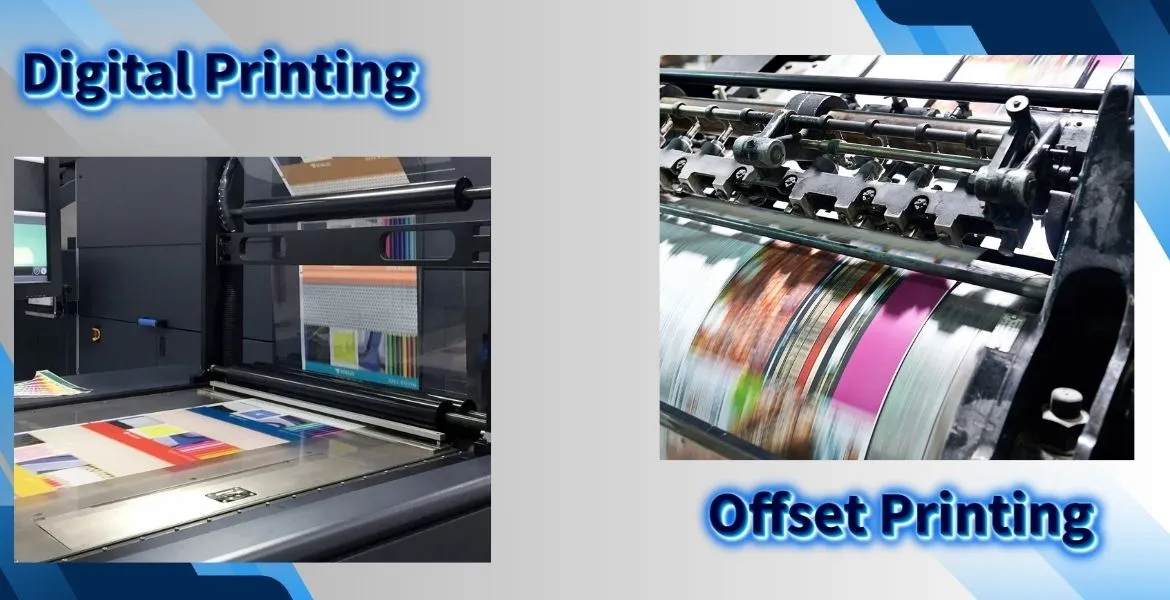
Printing choices are vital. They affect how your packaging product will look and feel. Good printing makes colors pop, text sharp, and images clear. Outdated printing formats can ruin your graphic design themes. Picking the right printing process saves money. And it keeps your project on time.
Many times, it becomes hard for businesses to decide the right printing method for their packaging products. Digital and offset printing are the two main options for businesses. Both of the printing processes have their own features and practical uses.
This blog will help you make smart decisions for your packaging supplies. Let’s step-by-step explore the digital printing method and the offset printing technique. We will also unleash their advantages and limitations.
What is Digital Printing?

Digital printing brings the graphic design directly from the computer to the digital printer. No plates. No long setup. It works fast and keeps details sharp. Colors stay consistent, even on small batches. This makes it ideal for quick jobs, test prints, and personalized projects.
It handles many materials, from paper to light paperboards. You can change designs without extra cost. Every print can be different. This process flexibility helps small businesses, retailers, and startups. They get high-quality prints without placing large orders. Digital printing keeps things simple, fast, and budget-friendly for short runs.
How Does Digital Printing Work?
In the following content, we have written all the steps of digital printing.
Step 1. File Preparation
Your artwork file is sent directly to the digital printer. No metal plates or dampening systems are needed.
Step 2. Machine Assigns the Colors
The digital printer reads the file pixel by pixel and assigns CMYK values to each one.
Step 3. Ink Application
Tiny dots of toner or liquid ink are sprayed or fused directly onto the material in the exact positions.
Step 4. Direct Printing
The image is built instantly, without mechanical transfer, keeping details sharp and gradients smooth.
Some machines add extra colors (metallics, white, light cyan/magenta) for better brand matching, especially on labels, packaging boards, and specialty papers.
What is Offset Printing?

The offset printing process is a relatively old method. In this process, ink moves from a metal plate to a rubber blanket. Then ink moves onto paper, paperboard, sticker, or other surfaces. CMYK color technique is its core method. This printing format is famous for consistent colors and sharp results.
Manufacturers and retailers use offset printing for bulk orders. So, if you want to print soap boxes or any type of retail boxes in bulk, then go with the offset printing technique. If you need labels, stickers, or books in larger quantities, even then, offset printing is the best.
Unlike digital printing, offset uses plates and mechanical transfer. Setup takes longer, but it’s very cost-effective for bulk orders. Brands rely on it for consistent, professional-quality prints at scale.
What is the Process of Offset Printing?
To know about the detailed offset printing process, you can read my other blog. The following is a brief description of the primary offset printing steps.
Step 1: Prepress Stage
The design is prepared digitally. Each CMYK color gets its own plate, while non-image areas stay blank.
Step 2: Inking the Plate
Ink rollers cover only the image areas on the plate. Water keeps the non-image areas clean in traditional presses.
Step 3: Transferring Ink to Blanket
The plate transfers the ink to a rolling rubber blanket. The blanket evens the image.
Step 4: Printing onto Substrate
The printing machine presses the blanket cylinder ink onto paper, cardboard, or other materials. An impression cylinder ensures even pressure and sharp results.
Step 5: Drying / Curing
Packaging companies let the ink dry naturally, with heat, or under UV light. Proper drying prevents smudging.
A Comparison of Advantages between Digital and Offset Printing
Now, We are going to draw a table. It will help you easily understand the differences between digital and offset printing. We have tried to sum up all the pros and cons in the comparison below as well..
| Features | Digital Printing | Offset Printing |
| Setup Cost | Low Cost. Only a computer and a digital printer are enough. | High Cost. Aluminum or photopolymer plates are needed. More workforce is required to print. |
| Per-Unit Printing Cost | Cost-effective for minimum orders and short runs. High cost for larger production runs. | Low cost for bulk orders and large runs. Expensive for short runs, samples, and prototypes. |
| Print Quality | Good quality with high-resolution results. | Industry-rated excellent standards. Consistent CMYK colors. |
| Printing Time | Fast and ideal for minimum order quantities. | A bit slower, but ideal for bulk orders. |
| Stocks Variation | Paper, stickers, labels, cardstock, SBS board, Kraft board, Buxboard, and limited thick paper options. | Paper, stickers, labels, cardstock, SBS board, Kraft board, corrugated cardboard, Grayboard (chipboard), and compatible with thick paperboards. |
| Waste Impact | Less setup waste | More setup and per-unit waste. |
| Finishing Options | No add-ons. Only CMYK printing. Short-run packaging printing. | Wide range of premium features such as varnish, aqueous coating, etc., with CMYK printing. |
| Durability | Good | Excellent and mostly long-lasting. Best printing method for boxes. |
Choose Digital or Offset Printing According to Your Requirements
So, the right printing method can save time. It also saves money and effort. Digital printing is considered perfect for short runs. Many of the businesses prefer it for their quick jobs and prototypes.
The digital printing method allows businesses to test packaging designs before placing final orders. Every digital print can be different according to the graphic design. Hence, this method offers you flexibility with low costs.
Offset printing shines when printing in bulk. When your orders are big then it delivers consistent and high-quality results. Retailers like this method for printing packaging boxes, labels, stickers, and brochures. Though its setup takes longer, the per-unit cost drops significantly.
Smart choices ensure your packaging looks sharp, vibrant, and professional every time. The help of printing experts is available online; you can avail yourself of it.
Key Takeaways
- The right printing method saves time and affects the look of the packaging product.
- Digital printing can be applied just from a computer without any plate or machine setup.
- Offset printing uses plates and a rubber blanket to transfer ink.
- Digital printing machines read artwork pixel by pixel.
- Digital machines apply toner or ink droplets.
- The digital printing process has a low setup cost but a higher per-unit cost for large runs.
- The offset method has a higher setup cost but a lower per-unit cost for bulk orders.
- Digital works on standard paper, cardstock, and light boards
- The digital printing method does not offer any finishing options.
- The offset process works on more stocks and supports various finishing choices.
- Use the digital printing method for making prototypes, short runs, and testing flexible packaging designs.
- Use the offset printing process for large runs.
- The offset method is also strongly recommended for high-quality packaging.
FAQs
Is digital printing good for packaging boxes?
Yes, digital printing is in practice for packaging boxes. Suppose you need quick production or small quantities, then it delivers sharp details and stable colors without long setup steps. Packaging experts mostly suggest it for prototypes, and where every piece can be different.
Which is cheaper: digital or offset printing?
Digital printing is inexpensive for minimum quantities. It does not need any plates or a lengthy setup. Offset becomes cheaper when orders grow, as the per-unit cost drops sharply. For larger runs, offset delivers better savings. For limited orders, digital remains the most economical and flexible choice.
Which printing method gives better color accuracy?
Offset printing gives better color accuracy because its plate and blanket system controls ink flow with tight stability. CMYK alignment stays consistent across thousands of sheets. Digital printing is strong but can vary slightly. For brand colors, gradients, and sensitive artwork, offset ensures predictable results.
Can I use offset printing for short runs?
Yes, you can use offset printing for short runs, but it is a bit expensive. Setup time, plate creation, and machine alignment increase the initial cost. Quality stays excellent, yet digital printing suits small batches better. Offset becomes practical when you need higher volumes or repeated, consistent production.
